
Interweaving for Deeper Impact
In this issue
- Cover
- Letter from the Director
- UNP Staff
- Interweaving for Deeper Impact
- Resident Leadership
- Education Pathways
- Engagement & Understanding
- Farewell to a Beloved Community Mural
- Remote Learning Supports for Families
- UNP's Commitments to Anti-Racism
- Donors & Supporters
- UNP Partnerships
- Partners
- Financial Report
- Board of Advisors
- Appeal for Support
Strategic Priority 1: Deepen the impact of UNP-supported partnerships through a stronger interweaving of west side neighborhoods, the University of Utah, and influential institutions around shared questions, priorities, and successful models.
Depth and Sustainability: Identify partnerships and strategies that are effective and have momentum. Focus on deepening that work and creating structures to support partnership sustainability.
Partnership Capacity: Support partners and partnerships in building their capacity to take on roles related to convening, goal setting, assessment, and evaluation.
Horizontal & Vertical Integration: Increase communication, resource sharing, and collaboration horizontally — across partnerships, sectors of the community, and stakeholders — and vertically, across levels of decision-making.
Knowledge Building: Deepen our shared knowledge base through community-engaged research foDeepen focused on the work and priorities of partnerships.
Key Indicator: # of active, collaborative connections within and across partnerships.
By Jennifer Mayer-Glenn; Director, UNP
Sometimes something beautiful grows in the ugliest of places. We saw that happen in March of 2020 when the University of Utah shocked us all by saying we needed to work from home. Us?! But our work is community engagement. How do we do that from home?
UNP staff experienced a lot of stress and anxiety, as did many others. In addition to figuring out how we were going to organize our community-engaged efforts from home, we worried about our loved ones and the many community members with whom we have relationships. We worried about each other. So, very early on, we decided that we should have a daily check-in.
Since the UNP staff all do our work in multiple locations, we typically have to work hard to be in the same place at the same time. As such, the virtual world became our place to connect, reconnect, and to learn more about each other at a much deeper level. Even now, nearly a year later, we check-in every day. It is our time to be vulnerable, human, and caring with each other.
We take turns facilitating our check-ins. Our questions have ranged from “What is your favorite bird?” to learning from Saolo Betham how to say, “Talofa/hello, O lo’u igoa o/my name is” in Samoan. We also heard the reverence in returning to a sometimes tender past when responding to, “How are these current day experiences similar to what your parents lived once upon a time?” This time and these questions have kept us grounded and connected. Something beautiful has grown in the virtual UNP garden.

The UNP Staff talking with one another via their daily Zoom check-ins: (top row to bottom row, left to right) Jennifer, Jewel, Julianne, Lenn, Paul, Saolo, Abdullah, Bruce, Teresa, Jasmine, Jarred, Abdulkhaliq, Farah, Amanda, Rosalia, and Almaida.
But the ugly came again. UNP staff did some difficult work after George Floyd’s murder to figure out how to speak…know what to say. In June, one of our check-in questions was, “What are one or two messages you would like UNP stakeholders (residents, University faculty/staff, and community institutions/organizations) to know regarding the impact of George Floyd’s murder and/or systemic racism on you?” Remember, two-thirds of our staff members identify as people of color. This was a hard question, a hard discussion, a hard day, a hard week.
That check-in question was the beginning of “A Letter to the UNP Community on Black Lives Matter and Anti-Racism”. We have since shifted those words to actionable commitments by participating together in continued dialogue about race, racism, and how both show up systemically, even within UNP.
These are not easy conversations. And, while there is little uglier than murder, we have found that we can grow and learn together so that we can hopefully bring more justice and kindness into this world.
Digital Navigators Connecting Residents
By Shauna Edson, Digital Inclusion Coordinator, The Salt Lake City Public Library & Rosalia Rosas, Digital Navigator, UNP
Salt Lake City community members have been coming to the City Library to use public computers or attend computer classes for decades. The COVID-19 pandemic response has shut down or severely reduced the ability of libraries and other community organizations to offer their existing digital inclusion programs. Millions of Americans need support from digital inclusion programs to get connected with affordable home internet, find affordable computing devices, and learn basic digital skills.
The City Library’s new Digital Navigators program is the latest way the Library is working to combat Salt Lake City’s “digital divide.” The program provides local residents with direct assistance to address their digital connectivity needs. The City Library recognizes the life changing significance of access to digital resources. A home internet connection opens up so many possibilities that some might take for granted: online healthcare, banking, applying for jobs, remote learning, and communicating with friends and family, just to name a few.
Digital Navigators can help connect people to free or low-cost internet service and devices and help with basic computer skills and training, including online privacy and security. Throughout the duration of this program, which will run through July of 2021, the Library will be working with University Neighborhood Partners, Suazo Business Center, and Catholic Community Services. This project was made possible in part by the Institute of Museum and Library Services grant number LG-248566-OLS-20, with support from Google Fiber and Friends of the City Library.
My name is Rosalia Rosas and I recently started working with UNP as a Digital Navigator.
I was born in the state of California and came to Utah when I was 14 years old so that my mom and stepfather could find jobs. We were sad to leave our friends and school in California, but my parents got jobs quickly. And, in a few years, their dream of buying a home came true. I graduated high school and got married, and my husband bought a house in Glendale. I have been living in the Glendale Community for about 14 years.
I have four kids and they went to Mountain View Elementary School and Glendale Middle School. I know many people in the Glendale community because I worked at Mountain View as a group leader in the afterschool program. I would help students with their homework and offer enrichment programs like computers, art, science, physical education, and music. I went on to become a teacher’s assistant in the kindergarten, and then a substitute teacher with Head Start. I have almost finished my Child Development Associates certificate to become a Head Start teacher.
I have been involved with UNP for about a year. I started working part time, running a small group doing activities with parents and their 4- to 5-year-old children in the UNP Hartland Partnership Center’s Head Start classroom. Then, because of COVID-19, I couldn’t do it anymore.
Now, UNP has hired me to be a Digital Navigator. I will be able to help families get computers and internet access at low or no cost. I can also help families learn to use computers and navigate the internet for work, school, and other things. I love doing this work because it gives me a chance to support my community.

Glendale Systems Mapping
By Julianne Rabb Clinical Director, UNP
In August 2019, leaders from the Salt Lake County Health Department began partnering with UNP to discuss specific issues regarding public health disparities within west side communities. Having identified community health issues that impacted our neighbors, including decreased life expectancy in comparison to east side communities, they requested input and guidance on how to best approach and support west side communities, focused on strengths, pride, and community knowledge. By September 2019, the Health Department committed to a “systems mapping project,” a 3-day consulting exercise at the Glendale Library that included more than 80 community members, community council leaders, and education and health system leaders. The sessions provided financial compensation for engagement, as well as language interpretation and childcare.
The systems mapping process identified authentic health disparities, community pride, and institutional investment as focuses for the community. UNP has begun the “socialization” of the information to larger systems to inform future impact. Dorothy Adams, Deputy Director of Salt Lake County’s Health Department, reported that, “As an organization we have learned that to impact the health outcomes of the communities we provide services to, we need to connect and build upon the trusted voices that already exist in these communities. By doing that, we recognize that our role is to have a seat at the table, listen and learn, and with that knowledge, adapt our programs to meet identified needs. It is our hope that by approaching our work with a systems knowledge, we will begin to make meaningful changes in health outcomes. The broad-based programmatic delivery that has historically been the model used for the provision of services, while viewed as equitable, in actuality is not. Determining how the trajectory of health outcomes in a community can be changed is not easy and is connected to other factors that traditionally were viewed as being outside the purview of public health. We know that the social determinants of health are connected to a community’s health outcomes, and therefore as a service provider, it is critical that we understand how these communities can and will connect to our services.”
Along the way, UNP realized one of the Health Department colleagues, Michell McGaughey, grew up in Glendale. We are so grateful for her origin story and her willingness to share it here!
“The opportunity to participate in the Glendale Community Mapping process has been the highlight of my career with the Health Department. I grew up in Glendale on Stewart Street and went to Mountain View Elementary and Glendale Jr. High. This mapping exercise felt like coming home. Hearing the stories of how close the community remains and the pride the residents (including some of my own family and friends who have remained in the area) have in the community, brought me to tears more than once in the days I spent at the Glendale Library during this event. When I was growing up in Glendale in the 1970s and 1980s, it was one of the most diverse communities in the city and that shaped the person I grew in to. The diversity represented in Glendale today is much greater than it was back then, and it makes me so proud that it has been fostered in my home community. What makes me more proud is the stories I heard of success, resiliency, and the will to keep fighting when things are hard.
“The connections we made during the planning and execution of the mapping exercise have helped us reach residents during the COVID pandemic and have expanded Salt Lake County Public Health’s ability to serve the community. The personal connections we as Health Department staff made during the event with Glendale residents made the successes and struggles real and personal, and we felt your joy and pain. I’m so proud to say I’m from Glendale and I’m looking forward to continuing the work we started.”
The systems map resulting from the event at Glendal Library can be seen online.
Hartland's Transformation
By Sydney Carillo, Student, University of Utah College of Architecture + Planning & the Design Build Salt Lake Team
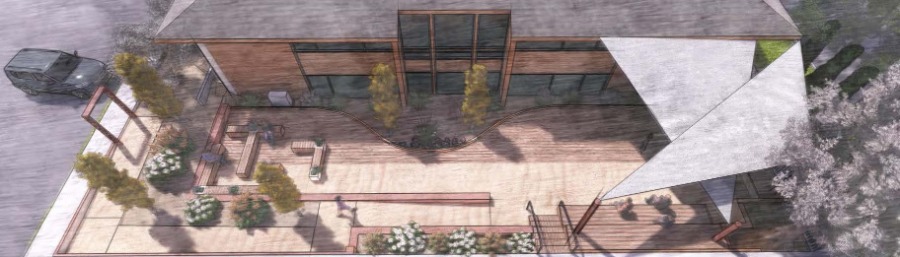
DBSL (DesignBuildSALTLAKE) is a student program in the University of Utah’s College of Architecture + Planning that allows students to gain hands-on education in design and construction. This year, the students have been lucky enough to work with UNP at its Hartland Partnership Center to design and build a landscape project for the community using the center. The 2020 Summer semester was dedicated to designing an outdoor classroom and community space.
 If you have been to UNP Hartland recently, you may have noticed some construction
happening on the north side of the building… that’s us! We have been working hard
over the past few months to construct the design that we developed over the summer.
From the beginning, the goal for the project was to work closely with the UNP Hartland
community to transform the landscape to support an educational, sustainable, and community
space. The diversity, community, and mission of UNP have continually inspired us.
We hope to encompass the spirit of UNP Hartland and create a space that uplifts its
ideals and diverse partnership offerings. We are proud to help support the needs of
a deserving community and look forward to the experiences and growth the project can
bring. We designed a landscape that we feel effectively supports gathering, educational
experiences, and continued growth.
We, as students, have chosen to be involved in this experience to learn more effective community engagement, team collaboration, and the process of design and construction. We learned that, like any project, there was a lot of problem solving. There have been setbacks and a learning curve throughout the process, but we have worked optimistically and eagerly through each obstacle set before us. Most of us, as students, have little to no construction experience and we have learned that setbacks and mistakes are inevitable in every building project. We, as a team, have been able to work together to create, learn, and find success.
We want to thank the community, University Neighborhood Partners, and the University of Utah’s College of Architecture + Planning for allowing us to gain this experience and knowledge. We are excited about the completion of the project. We are grateful for the friendships and hands-on experiences we have gained working together on this exciting community project.


